Every year in March, millions of Indian investors scramble to save tax under Section 80C. The two most popular choices are PPF (Public Provident Fund) and ELSS (Equity Linked Saving Scheme). Both give you a tax deduction of up to Rs 1.5 lakh per year — but they work completely differently. One is government-backed and safe, the other is market-linked and potentially far more rewarding. This guide breaks down everything you need to know before choosing.
What is PPF (Public Provident Fund)?
PPF is a government-backed savings scheme with a 15-year lock-in period. You can invest between Rs 500 and Rs 1.5 lakh per year. The current interest rate is 7.1% per annum, compounded annually. The entire investment — deposit, interest earned, and maturity amount — is completely tax-free under the EEE (Exempt-Exempt-Exempt) category.
PPF is one of the safest investments in India because it is backed by the sovereign guarantee of the Government of India. There is no market risk. Your returns are fixed and predictable.
What is ELSS (Equity Linked Saving Scheme)?
ELSS is a type of mutual fund that invests primarily in equity (stocks). It has the shortest lock-in period among all 80C investments — just 3 years. Returns are market-linked and not guaranteed. Historically, good ELSS funds have delivered 12% to 15% CAGR over the long term.
ELSS gains after 3 years are taxed as Long-Term Capital Gains (LTCG) at 12.5% above Rs 1.25 lakh per year. This makes ELSS slightly less tax-efficient than PPF, but the potential for higher returns more than compensates for most investors.
PPF vs ELSS — Quick Comparison Table
| Feature | PPF | ELSS |
| Returns | 7.1% p.a. (fixed) | 12–15% CAGR (market-linked) |
| Lock-in Period | 15 years | 3 years |
| Risk | Zero (govt backed) | Moderate to High |
| Tax on Investment | 80C deduction (up to Rs 1.5L) | 80C deduction (up to Rs 1.5L) |
| Tax on Returns | Fully tax-free (EEE) | LTCG 12.5% above Rs 1.25L/year |
| Tax on Maturity | Fully tax-free | LTCG applies |
| Min Investment | Rs 500/year | Rs 500 (lumpsum) / Rs 500 SIP |
| Max Investment | Rs 1,50,000/year | No upper limit (80C capped at Rs 1.5L) |
| Partial Withdrawal | From Year 7 onwards | After 3 years (full or partial) |
| Best For | Conservative, long-term savers | Wealth creation, risk-tolerant investors |
PPF vs ELSS Returns Comparison — Real Numbers Over 15 Years
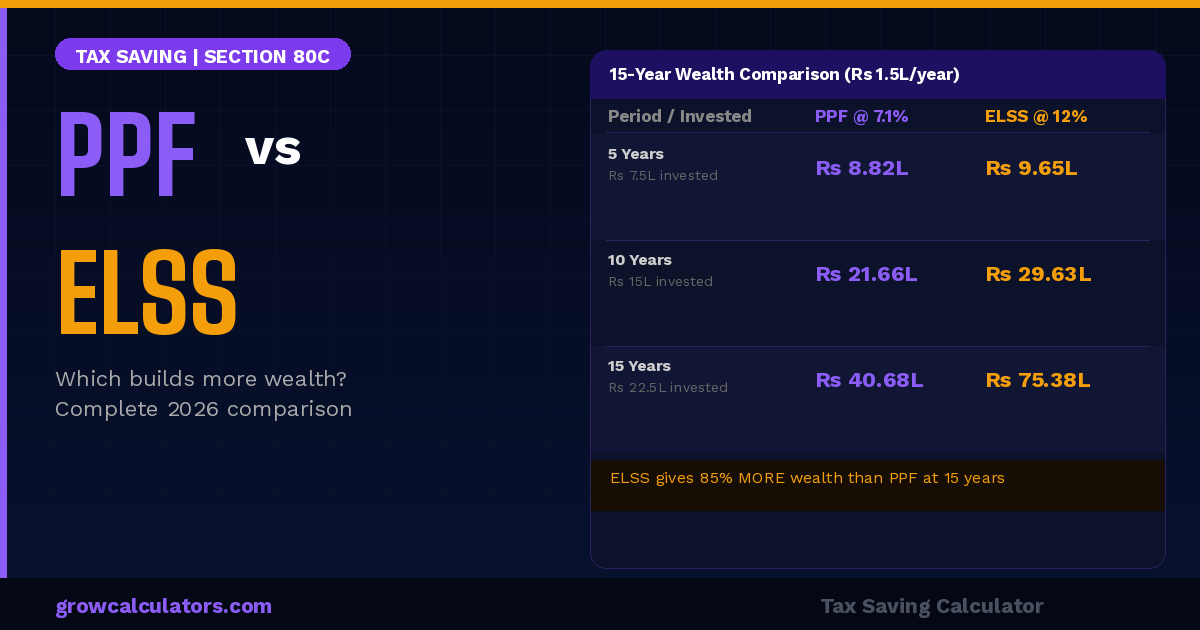
Let us compare what happens if you invest Rs 1.5 lakh per year in PPF vs ELSS over 15 years:
| Investment Period | Total Invested | PPF Maturity (@7.1%) | ELSS Maturity (@12%) | ELSS Maturity (@15%) |
| 5 Years | Rs 7,50,000 | Rs 8,82,000 | Rs 9,65,000 | Rs 10,23,000 |
| 10 Years | Rs 15,00,000 | Rs 21,66,000 | Rs 29,63,000 | Rs 34,06,000 |
| 15 Years | Rs 22,50,000 | Rs 40,68,000 | Rs 75,38,000 | Rs 1,00,14,000 |
Key insight: At 15 years, ELSS at 12% gives nearly 2x the returns of PPF. At 15% CAGR, ELSS crosses Rs 1 crore vs PPF’s Rs 40.68 lakh — a difference of Rs 60 lakh.
Tax Saving Comparison — Which Saves More Tax?
Both PPF and ELSS give the same 80C deduction benefit — Rs 1.5 lakh per year. The difference is in how the returns and maturity are taxed.
| Tax Benefit | PPF | ELSS |
| 80C Deduction | Rs 1,50,000/year | Rs 1,50,000/year |
| Tax saved (30% slab) | Rs 45,000/year | Rs 45,000/year |
| Tax on interest/gains | Zero (fully exempt) | LTCG 12.5% above Rs 1.25L/yr |
| Tax on maturity amount | Zero | LTCG 12.5% on gains above Rs 1.25L |
| Effective tax advantage | Higher (EEE — fully tax-free) | Lower but still very tax-efficient |
PPF has a clear tax advantage at maturity — you pay zero tax on your Rs 40+ lakh. With ELSS, if you earn Rs 75 lakh and invested Rs 22.5 lakh, your gain is Rs 52.5 lakh. After the Rs 1.25 lakh yearly exemption, you will pay LTCG at 12.5% on the remaining gains. This still leaves ELSS far ahead in absolute wealth creation despite the tax.
Lock-in Period: PPF 15 Years vs ELSS 3 Years
This is one of the most important differences. PPF locks your money for 15 years with partial withdrawals only from year 7. ELSS only requires a 3-year lock-in per investment.
With a monthly SIP in ELSS, each installment has its own 3-year lock-in. So if you start an ELSS SIP in January 2026, the January 2026 units are free in January 2029, February 2026 units are free in February 2029, and so on. This creates a rolling liquidity that PPF cannot match.
ELSS SIP gives you access to your money every month after the 3-year mark — ideal for medium-term goals like a car, home renovation, or education.
Real Example: Suresh (Age 30) Investing Rs 12,500/Month
Suresh wants to invest Rs 12,500 per month (Rs 1.5 lakh/year) for 15 years in a 80C instrument. Here is what each option gives him:
| PPF @ 7.1% | ELSS SIP @ 12% | |
| Total Invested | Rs 22,50,000 | Rs 22,50,000 |
| Maturity Value | Rs 40,68,000 | Rs 75,38,000 |
| Tax on Maturity | Zero | ~Rs 5,00,000 (LTCG est.) |
| Post-tax Wealth | Rs 40,68,000 | ~Rs 70,38,000 |
| Extra wealth vs PPF | — | Rs 29,70,000 more |
Even after paying LTCG tax, ELSS gives Suresh almost Rs 30 lakh more than PPF over 15 years. That is the power of equity compounding over time.
When Should You Choose PPF?
- You are extremely risk-averse and cannot tolerate any loss in your investment
- You are in the 30% tax slab and want fully tax-free maturity with zero risk
- You are saving for a long-term goal that is 15+ years away (retirement, child education)
- You want a forced savings discipline with guaranteed government-backed returns
- You already have significant equity exposure through stocks, NPS, or other mutual funds
When Should You Choose ELSS?
- You want significantly higher wealth creation over 10–15 years
- You can tolerate short-term market volatility for long-term gain
- You need flexibility — you may want to access money after 3 years
- You are under 45 years of age and have a long investment horizon
- You want to build a Rs 1 crore corpus for retirement or a major life goal
Can You Invest in Both PPF and ELSS?
Absolutely — and this is often the smartest strategy. Many financial advisors suggest splitting your Rs 1.5 lakh 80C investment between PPF and ELSS. For example:
| Profile | PPF Allocation | ELSS Allocation |
| Conservative (age 50+) | Rs 1,00,000/year | Rs 50,000/year |
| Balanced (age 35–50) | Rs 75,000/year | Rs 75,000/year |
| Aggressive (age 25–35) | Rs 50,000/year | Rs 1,00,000/year |
This gives you the safety floor of PPF (guaranteed returns, zero tax) combined with the growth engine of ELSS (equity upside). You get the best of both worlds.
PPF vs ELSS — Who Wins?
There is no single winner — it depends entirely on your age, risk appetite, and financial goals. Here is the final verdict:
| If you want… | Choose… |
| Guaranteed, risk-free returns | PPF |
| Maximum long-term wealth | ELSS |
| Fully tax-free maturity | PPF |
| Shorter lock-in (3 years) | ELSS |
| Best of both worlds | Split: 50% PPF + 50% ELSS |
Final Thoughts
PPF and ELSS are both excellent 80C tax-saving instruments — but they serve different purposes. PPF is your safety net: guaranteed, government-backed, fully tax-free. ELSS is your wealth creator: market-linked, higher potential, and far more liquid with its 3-year lock-in.
For most Indians in the 25–45 age group who have some risk appetite, ELSS is the better choice for maximum wealth creation. For those nearing retirement or with zero risk tolerance, PPF provides unmatched safety and tax efficiency. The smartest approach is to use both in a ratio that matches your risk profile.
Use our PPF Calculator and ELSS Calculator to run your own numbers and decide the right split for your financial goals.
Related Calculators: PPF Calculator | ELSS Calculator | SIP Calculator | Income Tax Calculator | XIRR Calculator