📅 March 2026 ⏱ 5 min read
Most Indians think of mutual funds as a tool to grow money — not to receive it monthly. But what if you could get a regular monthly payout from your mutual fund investments, just like a salary or pension?
That is exactly what SWP — Systematic Withdrawal Plan allows you to do. Whether you are retired, semi-retired, or simply want passive income, SWP is one of the smartest ways to create a steady cash flow from your existing investments.
In this guide, we explain how SWP works, how much you need to invest, and when it makes sense over a fixed deposit or dividend plan.
What is SWP (Systematic Withdrawal Plan)?
A Systematic Withdrawal Plan (SWP) lets you withdraw a fixed amount from your mutual fund at regular intervals — monthly, quarterly, or annually.
Instead of redeeming your entire investment at once, SWP redeems only the units needed to pay you the fixed amount you request. The rest of your money stays invested and continues to grow.
| 💡 SWP is the opposite of SIP. In SIP you invest a fixed amount every month. In SWP you withdraw a fixed amount every month. |
How Does SWP Work? — A Simple Example
Let’s say you have ₹50 lakh invested in a mutual fund with a NAV of ₹100 per unit. You set up an SWP of ₹25,000 per month.
Every month, the fund redeems enough units to give you ₹25,000. If NAV rises, fewer units are sold. If NAV falls, more units are sold. Your remaining corpus continues to grow.
| Month | Opening Corpus | Monthly Withdrawal | Fund Return (8% p.a.) | Closing Corpus |
| Month 1 | ₹50,00,000 | ₹25,000 | +₹33,333 | ₹50,08,333 |
| Month 2 | ₹50,08,333 | ₹25,000 | +₹33,389 | ₹50,16,722 |
| Month 3 | ₹50,16,722 | ₹25,000 | +₹33,445 | ₹50,25,167 |
| Month 6 | ₹50,41,500 | ₹25,000 | +₹33,610 | ₹50,50,110 |
| Month 12 | ₹50,83,200 | ₹25,000 | +₹33,888 | ₹50,92,088 |
Notice that your corpus actually grows even after monthly withdrawals — because the fund earns more than you withdraw. This is the power of SWP done right.
How Much Corpus Do You Need for SWP?
The key rule: your fund’s return must be higher than your withdrawal rate to sustain the corpus long-term.
Use our SWP Calculator to find the exact corpus needed for your monthly income target.
| Monthly Income Needed | Corpus Required (at 8% return) | Corpus Required (at 10% return) | Corpus Required (at 12% return) |
| ₹10,000 | ₹15,00,000 | ₹12,00,000 | ₹10,00,000 |
| ₹25,000 | ₹37,50,000 | ₹30,00,000 | ₹25,00,000 |
| ₹50,000 | ₹75,00,000 | ₹60,00,000 | ₹50,00,000 |
| ₹1,00,000 | ₹1,50,00,000 | ₹1,20,00,000 | ₹1,00,00,000 |
| ₹2,00,000 | ₹3,00,00,000 | ₹2,40,00,000 | ₹2,00,00,000 |
These figures assume the fund return equals the withdrawal rate or higher, keeping your corpus stable. If you withdraw more than the fund earns, your corpus will slowly reduce over time.
SWP vs Fixed Deposit vs Dividend Plan — Which is Better?
Many retirees rely on FD interest or dividend payouts for monthly income. Here is how SWP compares:
| Feature | SWP (Mutual Fund) | Fixed Deposit | Dividend Plan |
| Monthly Payout | Fixed amount of your choice | Fixed interest payout | Variable, not guaranteed |
| Tax on Income | Only capital gains tax on withdrawn units | Added to income, taxed at slab rate | Added to income, taxed at slab rate |
| Corpus Growth | Remaining corpus keeps growing | Corpus stays fixed | Corpus stays fixed |
| Flexibility | Change or stop anytime | Penalty on early withdrawal | Cannot control payout timing |
| Inflation Protection | Returns can beat inflation over time | Rate fixed, loses real value | Depends on fund performance |
| Best For | Long-term retirement income | Safe, guaranteed income | Occasional income, not regular |
| 💡 SWP is more tax-efficient than FD for most investors. FD interest is taxed at your income slab (up to 30%). In SWP, only the capital gains portion of each withdrawal is taxed — not the entire amount. |
Tax on SWP Withdrawals — What You Need to Know
Every SWP withdrawal has two parts: return of capital (your original investment) and capital gains (profit). Only the capital gains portion is taxed.
| Fund Type | Holding Period | Tax Rate |
| Equity Mutual Fund | Less than 1 year | STCG: 20% |
| Equity Mutual Fund | More than 1 year | LTCG: 12.5% (above ₹1.25 lakh) |
| Debt Mutual Fund | Any period | As per income tax slab |
| Hybrid Fund (Equity >65%) | More than 1 year | LTCG: 12.5% (above ₹1.25 lakh) |
For most retirees with equity fund SWP held over 1 year, the LTCG tax is minimal because each monthly withdrawal redeems only a small number of units.
Use our Income Tax Calculator to estimate your annual tax liability from SWP withdrawals.
Which Mutual Fund is Best for SWP?
Not all funds are suitable for SWP. Here is what to look for:
- Balanced Advantage Funds: Automatically shift between equity and debt based on market conditions. Ideal for SWP as they reduce downside risk while maintaining growth.
- Large Cap or Index Funds: Lower volatility than mid/small cap. Better for SWP as NAV swings are smaller.
- Hybrid / Conservative Hybrid Funds: Mix of equity and debt. Suitable for risk-averse retirees who still want some growth.
- Avoid: Small cap, sector, or thematic funds for SWP. High volatility means more units get redeemed during market crashes, depleting your corpus faster.
| Fund Category | Risk Level | Expected Return | SWP Suitability |
| Large Cap / Nifty 50 Index | Low-Medium | 10–12% p.a. | ⭐⭐⭐⭐⭐ Excellent |
| Balanced Advantage Fund | Low-Medium | 10–11% p.a. | ⭐⭐⭐⭐⭐ Excellent |
| Conservative Hybrid Fund | Low | 8–9% p.a. | ⭐⭐⭐⭐ Good |
| Mid Cap Fund | High | 12–15% p.a. | ⭐⭐ Not Ideal |
| Small Cap Fund | Very High | 15–18% p.a. | ⭐ Avoid for SWP |
| Debt / Liquid Fund | Very Low | 6–7% p.a. | ⭐⭐⭐ Suitable for short term |
Smart SWP Strategy: The 4% Rule for Indian Investors
The 4% rule says: withdraw no more than 4% of your corpus per year (about 0.33% per month). At this rate, most diversified equity funds have historically sustained the corpus for 25–30 years.
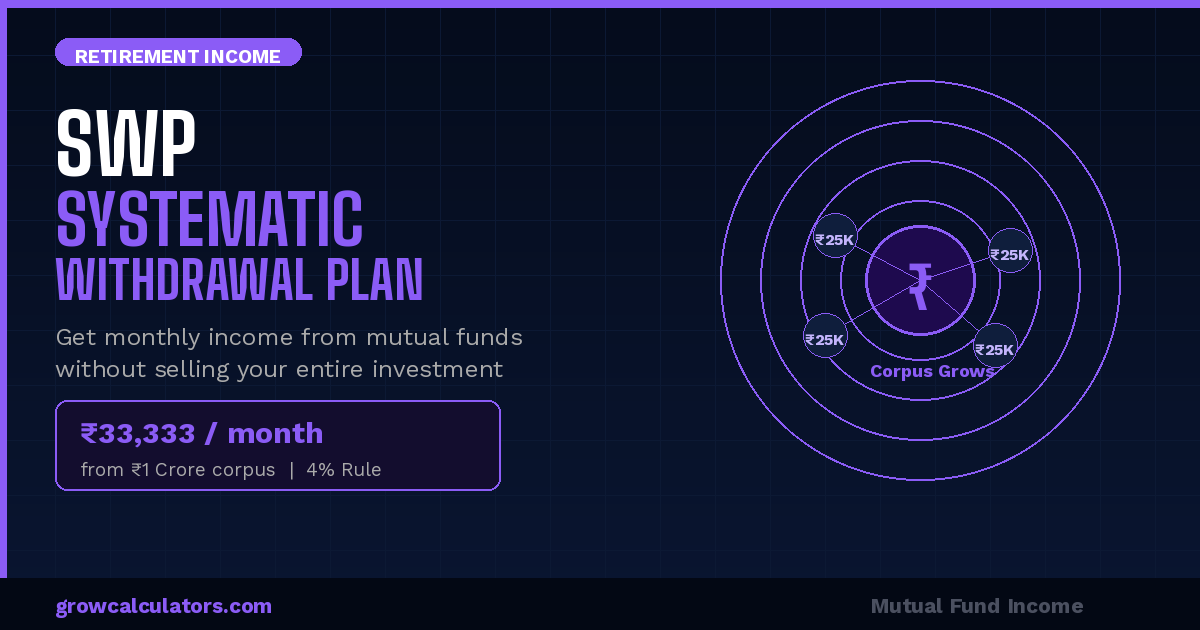
| 💡 If you have ₹1 crore invested, safe monthly SWP = ₹1,00,00,000 × 4% ÷ 12 = ₹33,333 per month. This keeps your corpus intact for decades. |
For a more detailed SWP plan tailored to your corpus and income needs, use our SWP Calculator. You can also combine SWP with SIP — continue SIPs in your accumulation phase, then switch to SWP at retirement.
When NOT to Use SWP
- When your investment horizon is less than 3 years — short-term market volatility can erode your corpus.
- If you need guaranteed income — SWP returns are market-linked, unlike FD which gives fixed interest.
- If you are invested in highly volatile small cap or sectoral funds — high NAV swings mean unpredictable unit redemptions.
- If your corpus is too small relative to your monthly need — withdrawing more than your fund earns will slowly drain the corpus to zero.
Conclusion: Is SWP Right for You?
SWP is one of the most tax-efficient and flexible ways to generate monthly income from mutual funds. If you have a large enough corpus (typically ₹30 lakh or more) and invest in the right fund category, SWP can replace or supplement your salary, pension, or FD income.
The key is to withdraw at a sustainable rate — ideally 4% per year or less — so your corpus keeps growing even as you take monthly payouts.
| Your Situation | Recommended Action |
| Building corpus for future income | Start SIP now → Switch to SWP at retirement |
| Already retired with ₹30L+ invested | Set up SWP in balanced advantage or large cap fund |
| Need guaranteed income, hate market risk | FD or Senior Citizens Savings Scheme (SCSS) |
| Want both income + growth | SWP from equity fund + small FD for stability |
Ready to calculate your SWP? Use our SWP Calculator to find out exactly how much monthly income your corpus can generate. Also explore our Lumpsum Calculator and SIP Calculator to plan your wealth-building journey.
— Published on GrowCalculators.com | Investment Guides