📅 March 2026 ⏱ 5 min read
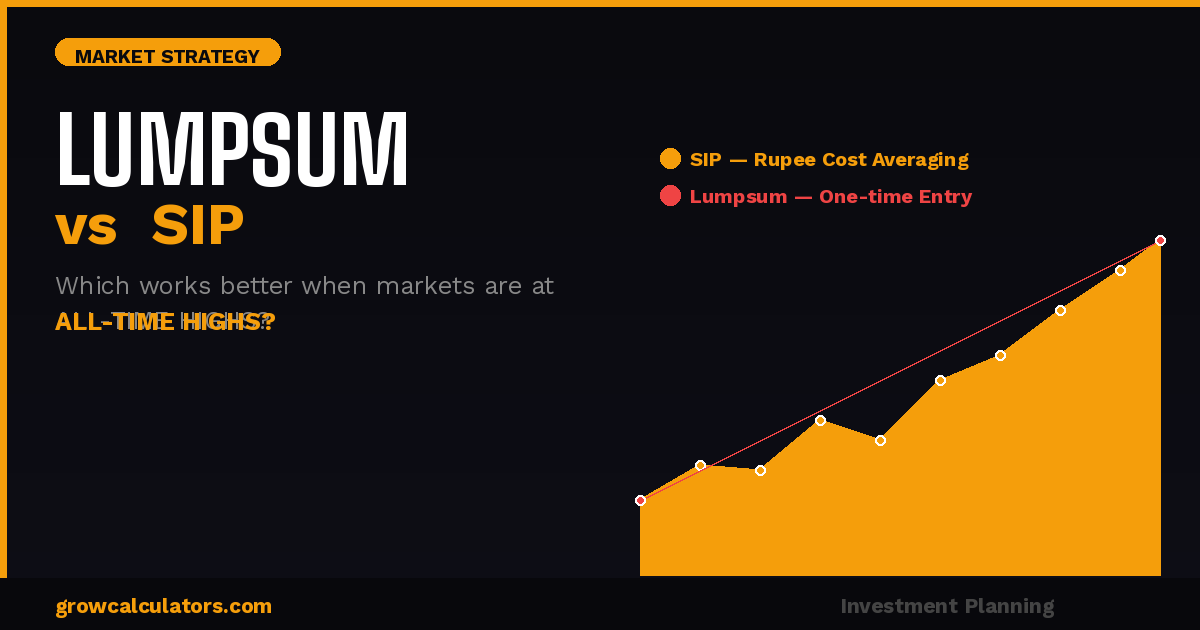
Markets just hit an all-time high. Your ₹2 lakh is sitting in a savings account. The big question: do you put it all in at once, or split it into monthly SIPs? This is one of the most debated questions in personal finance — and the answer is more nuanced than you think.
What is a Lumpsum Investment?
A lump sum investment means putting all your money into a mutual fund in a single transaction. If you invest ₹2,00,000 today, all of it starts earning (or losing) from today.
You can calculate your lump sum returns using our free Lumpsum Calculator.
What is a SIP?
A Systematic Investment Plan (SIP) means investing a fixed amount every month. Instead of ₹2,00,000 today, you might invest ₹10,000 per month for 20 months. This spreads your investment across different market levels.
Plan your SIP targets using our SIP Calculator or the Step-up SIP Calculator if you plan to increase your SIP every year.
The Core Difference: Market Timing Risk
| Factor | Lumpsum | SIP |
| Entry point | Single market level | Multiple market levels (averaged) |
| Risk if market falls after entry | High — full corpus exposed | Lower — only 1 month’s amount exposed |
| Risk if market keeps rising | You benefit fully | You miss early gains on future instalments |
| Best in bull market | ✅ Yes | ❌ Partial benefit only |
| Best in volatile market | ❌ Risky | ✅ Rupee cost averaging kicks in |
| Discipline required | Low (one-time action) | High (monthly commitment) |
| Ideal for | Bonus, inheritance, FD maturity | Monthly salary investors |
What Happens When You Invest at All-Time Highs?
This is the big fear — ‘what if the market crashes right after I invest?’ History shows that all-time highs are regularly broken. Markets reach new highs consistently over 10–20 year periods. In fact, data from Nifty 50 over the last 20 years shows that investing at an all-time high still delivered positive returns in 90%+ of cases when held for 5+ years.
| 📊 Nifty 50 Scenario: If you had invested a lump sum on every ‘all-time high’ between 2003–2023 and held for 5 years, you would have earned positive returns 94% of the time. |
Rupee Cost Averaging: SIP’s Hidden Power
When you invest via SIP, you buy more units when markets are low and fewer units when markets are high. This is called rupee cost averaging, and it naturally reduces your average cost per unit over time.
| Month | NAV (₹) | SIP Amount (₹) | Units Bought |
| Jan | 100 | 10,000 | 100.00 |
| Feb | 90 | 10,000 | 111.11 |
| Mar | 85 | 10,000 | 117.65 |
| Apr | 95 | 10,000 | 105.26 |
| May | 110 | 10,000 | 90.91 |
| Total | — | 50,000 | 524.93 units @ avg ₹95.25 |
If you had invested ₹50,000 as lump sum in January at NAV ₹100, you would have only 500 units. SIP gave you 524.93 units for the same money — that is rupee cost averaging at work.
Lumpsum Wins When Markets Go Straight Up
| Scenario | Lumpsum ₹2L @10% pa (5 yr) | SIP ₹10k/month (5 yr total ₹6L) |
| Market rises steadily | ₹3,22,102 | Depends on entry NAV — approx ₹7.8L |
| Market volatile, flat end | ₹2,20,000 approx | ₹7.2L approx (cost averaging helps) |
| Market crashes 30% then recovers | ₹2,80,000 approx | ₹8.1L approx (SIP wins big) |
Note: SIP amounts above reflect 5 years of ₹10,000/month = ₹6L invested vs ₹2L lumpsum. Use our Lumpsum Calculator and SIP Calculator together to compare scenarios for your actual numbers.
The Smart Middle Ground: STP
If you have a lump sum but are scared of all-time highs, use a Systematic Transfer Plan (STP). Park your money in a liquid/debt fund and transfer a fixed amount every month to an equity fund. This gives you the benefits of SIP while your full corpus is already invested and earning.
Which Should You Choose?
- If you have a one-time windfall (bonus, maturity proceeds) → STP or phased lumpsum over 3–6 months
- If you are a salaried investor with monthly surplus → SIP every month without thinking about market levels
- If markets are at 52-week lows → Lumpsum is more attractive
- If markets are at all-time highs and you are risk-averse → SIP or STP
- If your horizon is 10+ years → Lumpsum vs SIP difference becomes negligible
Related Calculators
→ Mutual Fund Return Calculator
→ XIRR Calculator — Know your true returns
Conclusion
At all-time highs, SIP is the safer and psychologically easier choice for most investors. Lumpsum is mathematically better when markets keep rising — but no one can predict that. For long-term wealth creation, consistency matters more than timing. A SIP you stick to is far better than a lumpsum you panic-sell after a 10% correction.
| 💡 Pro tip: Combine both. Invest 30–40% as lumpsum immediately, and SIP the rest over 12 months. This balances opportunity cost and market timing risk. |