📅 March 2026 ⏱ 5 min read
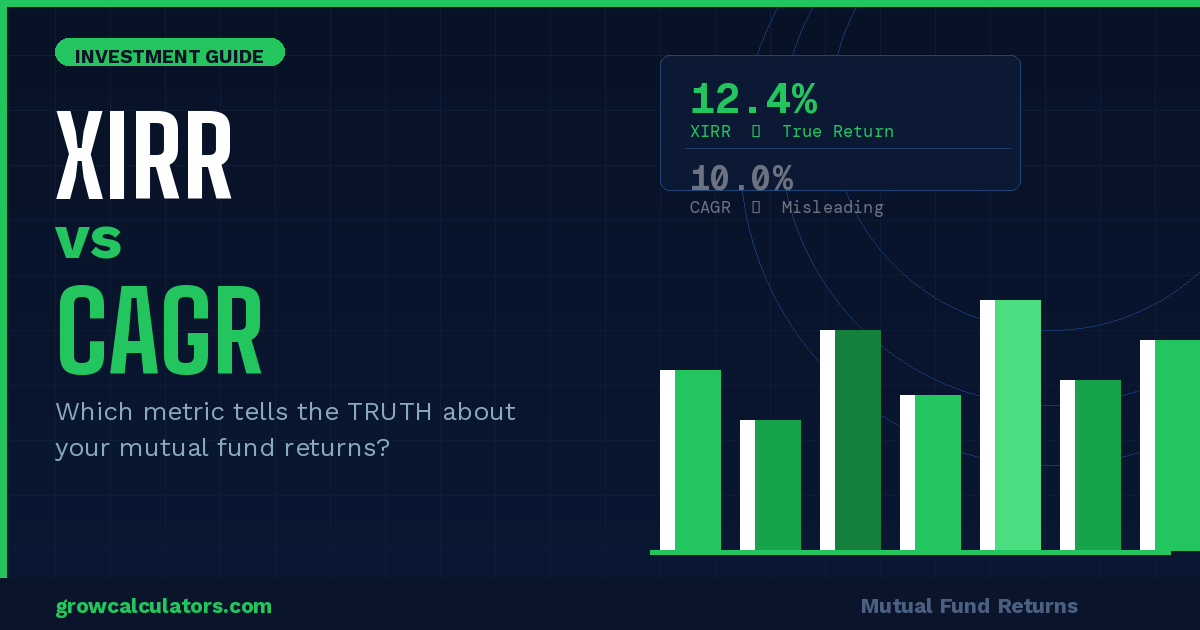
When you check your mutual fund returns, you often see two terms: XIRR and CAGR. Most investors ignore the difference — but that mistake can make you completely misread how your investments are actually performing. In this guide, we explain both clearly and show you exactly when to use which.
What is CAGR?
CAGR stands for Compound Annual Growth Rate. It measures how much an investment has grown per year over a fixed period, assuming a single lump sum investment made on Day 1 and withdrawn on the last day.
Formula: CAGR = [(Ending Value / Beginning Value)^(1/n)] – 1
| 💡 Example: You invest ₹1,00,000 in a mutual fund. After 5 years it becomes ₹1,80,000. CAGR = [(1,80,000/1,00,000)^(1/5)] – 1 = 12.47% per year. |
CAGR is perfect for evaluating lump sum investments. You can use our free
CAGR Calculator to calculate this instantly.
What is XIRR?
XIRR stands for Extended Internal Rate of Return. It is used when you make multiple investments at different times — like monthly SIPs — or take multiple withdrawals. XIRR calculates the annualised return for irregular cash flows.
Formula: XIRR solves for ‘r’ such that: NPV of all cash flows = 0
| 💡 Example: You invest ₹5,000/month via SIP for 3 years. The total invested is ₹1,80,000 and the final value is ₹2,40,000. CAGR would be misleading here. XIRR gives the true annualised return accounting for every monthly investment date. |
XIRR Calculator to find your real SIP returns.
CAGR vs XIRR: Key Differences
Here is a side-by-side comparison to help you choose the right metric:
| Feature | CAGR | XIRR |
| Best for | Lump sum investments | SIP / irregular cash flows |
| Cash flows | Single entry, single exit | Multiple entries & exits |
| Accuracy for SIP | ❌ Misleading | ✅ Accurate |
| Complexity | Simple formula | Requires iteration / software |
| Where you see it | Fund fact sheets, FD returns | Mutual fund apps, Zerodha, Groww |
Why CAGR is Misleading for SIPs
Imagine you invest ₹10,000 every month in a SIP. Your first instalment earns returns for 10 years, but your last instalment only earns returns for 1 month. Using CAGR for this portfolio is like calculating the average speed of a journey where you started walking and ended running — the number hides the full story.
XIRR solves this by assigning a specific date to each cash flow. It asks: ‘What single annual interest rate would make all these investments grow to exactly this final value?’ That is your true return.
Real-World Example: SIP Returns
| Month | SIP Amount (₹) | Value at End (₹) | CAGR (misleading) | XIRR (accurate) |
| Month 1 | 10,000 | 16,105 | 10%* | 12.4% |
| Month 12 | 10,000 | 14,641 | 10%* | 12.4% |
| Month 24 | 10,000 | 12,100 | 10%* | 12.4% |
| Month 36 (last) | 10,000 | 11,000 | 10%* | 12.4% |
*CAGR applied to total corpus ignores timing — all months get the same rate. XIRR is the only correct metric here.
When to Use Which?
- Use CAGR when comparing fixed deposits, NSC or any lump sum instrument
- Use XIRR for SIP returns, portfolio returns with multiple investments
- Use CAGR for mutual fund fact sheets (they always show lump sum performance)
- Use XIRR when your mutual fund app shows ‘absolute return’ and you want annualised
Related Calculators on GrowCalculators
→ XIRR Calculator — Find true SIP returns
→ CAGR Calculator — Lump sum return analysis
→ SIP Calculator — Plan your monthly investments
→ Mutual Fund Return Calculator — Compare MF performance
→ Step-up SIP Calculator — Calculate returns when you increase SIP annually
Conclusion
Both CAGR and XIRR are powerful — but only if used in the right context. For lump sum investments in FDs, NPS or one-time mutual fund purchases, CAGR is your metric. For SIPs and portfolios with irregular cash flows, always use XIRR. Most Indian investors never check XIRR — do not be one of them.
| 🔗 Bookmark our XIRR Calculator and CAGR Calculator so you always have the right tool at hand. |